
A device this thin has no business doing this much. Most of the time, it delivers.
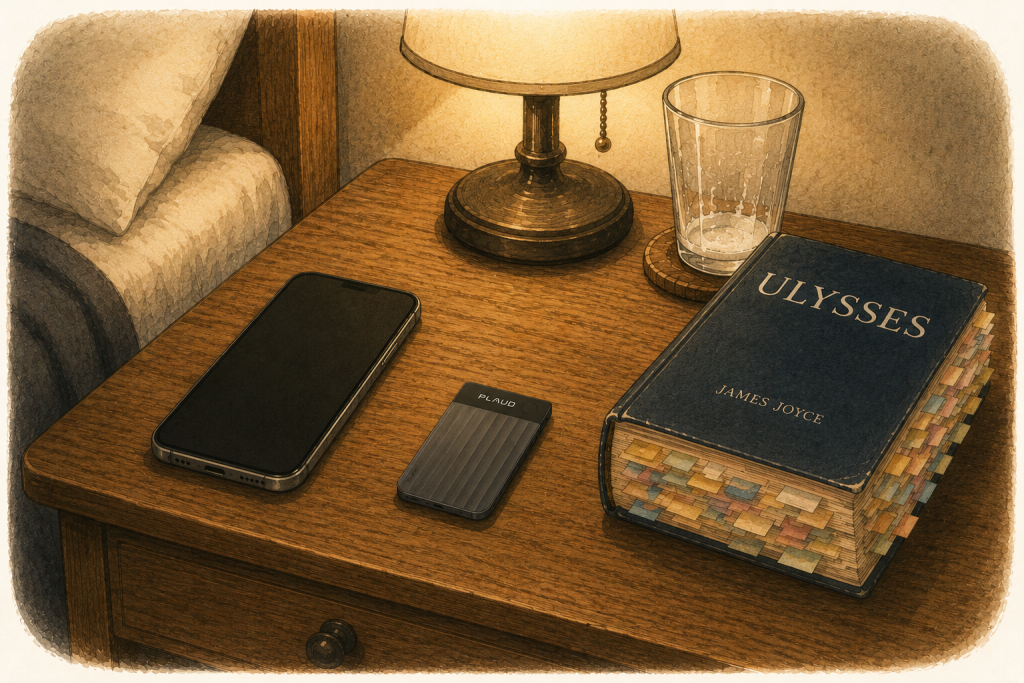
| Manufacturer | PLAUD AI |
| Model | Note Pro |
| Form factor | Credit-card size, 0.12 inches thin, 1.06 oz |
| Microphones | Quad MEMS array with AI directional audio |
| Recording modes | Meeting and call (auto-switching) |
| Battery life | 30 hours continuous recording |
| Languages | 112 |
| Display | InstantView (status and recording info) |
| Connectivity | MagSafe / magnetic ring for Android |
| AI models | ChatGPT-5, Gemini 2.5 Pro, Claude Sonnet 4 |
| Transcription accuracy | 90-95% for native English speakers |
| Free plan | 300 transcription minutes/month |
| Pro plan | 1,200 minutes/month — verify pricing at plaud.ai |
| Unlimited plan | Verify pricing at plaud.ai |
| Compliance | HIPAA, SOC 2, ISO 27001/27701, GDPR |
| In the box | Note Pro device, magnetic case, magnetic ring, charging cable |
| Hardware price | ~$189 – Confirm current pricing at Amazon before buying |
This post contains affiliate links. If you buy through them, I may earn a commission at no extra cost to you. Full disclosure policy.
Bottom line: The PLAUD Note Pro is a credit-card-thin AI voice recorder that transcribes, summarizes, and organizes your recordings using multiple AI models, automatically, on a device that fits in a wallet. The hardware is genuinely impressive, the transcription accuracy is among the best in the category, and the quad-microphone array handles real rooms rather than just clean podcast conditions. The app has documented connectivity issues, the subscription model layers ongoing cost onto an already-premium hardware purchase, and the privacy considerations around recording conversations are real and worth thinking through before you buy. For writers who interview sources, attend meetings, or dictate on the go, this is the most capable dedicated AI recorder available.
Scribbright rating: 4 out of 5
→ See all focus and productivity tools reviewed at Scribbright.
What the PLAUD Note Pro is
That interview you’re doing for your next article/book/other opus is going great, right? Then you look down at your smartphone and see the recording has stopped because you just got a text from your significant other. Or your ancient Olympus tape recorder has drained its AAs.
Here’s a wafer-thin solution. To technical troglodytes (a.k.a., Boomers like me) it’ll be a revelation. Almost scary in its sheer…smallness, let’s face it.
PLAUD AI launched the original Note in 2024 and the Note Pro in October 2025. The Pro is significantly different from its predecessor, not just a cosmetic refresh. It’s got better microphones, an InstantView display, automatic mode switching between meeting and call recording, document capture via the app camera, and access to multiple AI models for transcription and summarization.
The hardware proposition is a credit-card-sized aluminum device, 0.12 inches thin and just over an ounce, that snaps magnetically to the back of an iPhone via MagSafe or to any phone via an included magnetic ring. Press the button to record. The device captures audio, stores it onboard, and syncs to the PLAUD app when you’re back on Wi-Fi. The app handles everything else: transcription, summarization, speaker labeling, mind maps, action items, and a conversational “Ask PLAUD” feature that lets you query your own recordings.
The AI models doing the work are ChatGPT-5, Gemini 2.5 Pro, and Claude Sonnet 4, which is an unusually strong lineup for a consumer hardware device and goes some way toward explaining the transcription accuracy numbers.
→ Find the PLAUD Note Pro on Amazon.
Why writers should care
The obvious use cases for a device like this are business meetings, sales calls, and corporate note-taking. Those are real and well-served. But writers have a separate set of use cases that the PLAUD Note Pro handles with particular effectiveness.
Interviews. Journalists and nonfiction writers who conduct interviews spend significant time on transcription after the fact, or pay for transcription services. The PLAUD Note Pro compresses that workflow: record the interview, sync to the app, receive a labeled transcript with speaker identification. The 90 to 95 percent accuracy rate for native English speakers is high enough to produce a usable first draft without extensive correction. The “Ask PLAUD” feature lets you query the recording afterward to pull specific quotes or confirm details without scrubbing through audio.
Dictation. Writers who think out loud, who draft by speaking rather than typing, or who capture ideas while walking have typically had to manage a separate voice memo workflow before transcription. The PLAUD Note Pro handles both sides of that in a single device. The 30-hour battery means it’s available whenever the idea arrives without needing to charge it first.
Research and lectures. Students and academic writers attending lectures or conferences can record and receive structured summaries rather than manually transcribing notes. The 112-language support handles multilingual research environments.
Notetaking. When a crucial story note pops into your head, or that vivid dream you just woke up from seems like the nut of a perfect screenplay? Don’t scrabble around for a pen and paper when you’ve got this handy.
The privacy caveat. None of the above happens without acknowledging what’s obvious: recording other people requires their knowledge and consent. Most jurisdictions have specific laws about recording conversations, and they vary. PLAUD includes a reminder in its own documentation to inform participants and obtain consent before recording. For writers who conduct formal interviews, this is standard professional practice. For anyone using the device in less structured environments, it’s worth knowing the legal requirements in your specific location before pointing a microphone at a conversation.
The hardware
The Note Pro’s form factor is its most immediately impressive attribute. At 0.12 inches thin and 1.06 ounces, it disappears into a pocket or snaps flat against the back of a phone without adding meaningful bulk. The rippled aluminum design earned an iF Design Award in 2026, which is either meaningful or marketing depending on your view of design awards, but the hardware does feel considered rather than generic.
The quad MEMS microphone array is the functional centerpiece. Four microphones with AI spatial awareness capture voices with directional audio, prioritizing the main speaker while reducing ambient noise. Independent testing confirms it captures voices accurately up to roughly ten feet in standard environments, with accuracy dropping at fifteen feet. For a device this size, that’s a genuine technical achievement. It handles conference rooms. It handles noisy restaurants. It doesn’t perform miracles at distance.
The InstantView display is a small status screen that shows recording mode, battery level, and storage without requiring you to open the app. It sounds minor and turns out to be more useful than it sounds in practice: knowing the device is recording without pulling out your phone is the difference between unobtrusive professional use and an awkward glance at your screen every few minutes.
The 30-hour continuous battery life is one of the strongest specifications in the category. Most competing devices run eight to twelve hours. Not needing to charge the PLAUD Note Pro nightly removes a meaningful friction point for daily use.
The app and AI layer
The PLAUD app handles transcription, summarization, and organization after recordings sync from the device. The AI processing draws on ChatGPT-5, Gemini 2.5 Pro, and Claude Sonnet 4 depending on the task, and produces transcripts with automatic speaker labeling, structured summaries, mind maps, to-do lists, and custom output formats from a library of over 10,000 templates.
The “Ask PLAUD” conversational feature lets you interrogate your own recordings after the fact: pull specific quotes, ask what was decided, identify action items, draft follow-up emails. For writers who conduct long interviews and need to locate a specific exchange without scrubbing through audio, this is the feature that changes the workflow most fundamentally.
The app’s documented weakness is connectivity. Or, rather, the occasional lack of it. Multiple user reviews and independent testing flag intermittent Bluetooth and Wi-Fi sync issues, a buggy connection experience on some devices, and a manual Wi-Fi transfer process that is slower than the cloud-native apps it competes with at the software level. The app was rebuilt as PLAUD App 3.0 alongside the Note Pro launch, which resolved some earlier issues, but connectivity complaints persist in recent reviews. This is the category where the hardware most clearly outperforms the software that supports it.
The subscription cost to keep in mind
The PLAUD Note Pro is a hardware purchase with a subscription attached, and so do some total cost calculation before buying.
Every device ships with the free Starter Plan: 300 transcription minutes per month, which is five hours. For writers who conduct occasional interviews or capture sporadic voice notes, that’s likely enough. For writers who record meetings daily or conduct multiple long-form interviews per month, the free tier runs out in a hurry.
The Pro Plan adds significantly more monthly transcription minutes; the Unlimited Plan removes the cap entirely. Verify current pricing at plaud.ai before buying, as these rates have changed since launch and may change again. The total year-one cost of hardware plus a Pro or Unlimited subscription is worth calculating against the alternatives, including software-only transcription tools like Otter.ai, which work on subscription-only models without hardware cost but are limited to online meeting environments and lack the physical room recording capability of the Note Pro.
The hardware records and stores audio regardless of subscription status. The subscription gates the AI transcription and summarization features specifically. A writer who wants only a high-quality voice recorder and handles transcription separately can use the device without a paid plan.
Its limitations?
App connectivity. Documented and recurring. Better than the original Note’s app experience, not yet resolved to the standard this very slick hardware deserves.
Background noise pickup. The quad-microphone array handles rooms well, but picks up laptop fans, ambient music, and environmental noise alongside voices. This doesn’t typically affect transcription accuracy, but the raw audio files reflect everything in the room.
Sync friction. Manual Wi-Fi transfer is slower than cloud-native competitors for users who need immediate post-meeting access to transcripts.
Subscription on top of hardware. At the volume where the PLAUD Note Pro delivers maximum value, the free tier is likely insufficient. Factor the annual subscription cost into the buying decision.
App dependency. The device is ultimately a recording and storage vehicle. Everything useful happens in the app. If PLAUD as a company changes direction, the hardware’s utility depends on the continued operation of the PLAUD platform.
Pros
- Hardware design is genuinely exceptional: credit-card thin, MagSafe integration, premium aluminum build
- Quad MEMS microphone array handles real rooms, conferences, and noisy environments accurately
- 30-hour battery life is significantly stronger than most competing devices
- Transcription accuracy of 90 to 95 percent for native English speakers is among the best in the category
- AI layer draws on ChatGPT-5, Gemini 2.5 Pro, and Claude Sonnet 4
- “Ask PLAUD” conversational feature is genuinely useful for post-interview reference
- 112-language support
- Free Starter Plan provides 300 minutes per month with no commitment
- HIPAA, SOC 2, and ISO compliance for regulated professional environments
- InstantView display removes the need to check the app during recording
Cons
- App connectivity issues are documented and persistent
- Subscription required for full AI transcription features beyond 300 minutes per month
- Total year-one cost (hardware plus subscription) is higher than software-only alternatives
- Manual Wi-Fi sync is slower than cloud-native transcription apps
- Background noise appears in raw audio files even when transcription handles it correctly
- Full utility depends on continued PLAUD platform operation
- Recording conversations requires informed consent; legal requirements vary by jurisdiction
The verdict
The PLAUD Note Pro may be the most capable dedicated AI voice recorder available for writers who need to capture real-world conversations rather than just online meetings. The hardware is excellent, the transcription accuracy is high, and the AI summarization layer handles post-recording workflow in ways that meaningfully reduce the time between a conversation and usable notes.
The app is the weak link, the subscription is a real additional cost that needs to factor into the buying decision, and the privacy considerations around recording conversations are worth some thought before the device goes into your bag.
For writers who interview sources regularly, dictate ideas on the go, or attend events and conferences where capturing what was said matters more than keeping up with a notepad: the PLAUD Note Pro earns its keep.
→ Find the PLAUD Note Pro on Amazon.
Michael Semer is a professional writer and editor with 40 years of experience in advertising, B2B content marketing, and digital publishing. This review is based on extensive research and documented user experience.
→ More focus and productivity tools reviewed at Scribbright.
Frequently asked questions
What is the PLAUD Note Pro? A credit-card-thin AI voice recorder that captures audio in meetings and phone calls, then uses AI to produce transcripts, summaries, action items, and mind maps via the PLAUD app. It’s the premium version of the original PLAUD Note, launched in October 2025, with improved microphones, an InstantView display, and automatic mode switching.
How accurate is PLAUD Note Pro transcription? Around 90 to 95 percent for native English speakers in standard environments, which is among the highest in the consumer AI recorder category. Accuracy is lower for non-native speakers, fast talkers, or recordings with significant background noise. The quad MEMS microphone array handles noisy environments better than most competing devices, which limits but doesn’t eliminate the accuracy drop in difficult conditions.
Do I need a subscription to use the PLAUD Note Pro? The hardware records and stores audio without a subscription. The AI transcription and summarization features require the PLAUD app and are gated by a usage plan. Every device ships with a free Starter Plan covering 300 transcription minutes per month. Heavy users will need a paid plan. Verify current subscription pricing at plaud.ai before buying.
How does the PLAUD Note Pro compare to Otter.ai? Different tools for different environments. Otter.ai is a software-only transcription service that excels at virtual meetings on Zoom, Teams, and Google Meet, with collaborative features for teams. The PLAUD Note Pro handles physical rooms, in-person conversations, and phone calls where software-only tools can’t access the audio. For writers who conduct face-to-face interviews or attend live events, the PLAUD Note Pro does things Otter.ai cannot. For writers who work entirely in virtual meeting environments, Otter.ai is a simpler and cheaper solution.
Is it legal to record conversations with the PLAUD Note Pro? It depends on your jurisdiction. Recording laws vary significantly: some require all parties to consent, others require only one party. PLAUD includes a reminder in its own documentation to inform participants and obtain consent before recording. For professional interview use, informing your subject that you’re recording is standard practice. For any other use, understand the specific legal requirements where you are before recording.
What AI models does PLAUD Note Pro use? ChatGPT-5, Gemini 2.5 Pro, and Claude Sonnet 4. The app draws on multiple models depending on the task, which produces stronger results than devices relying on a single AI provider.
What is the battery life on the PLAUD Note Pro? 30 hours of continuous recording in Enhance mode, and up to 60 days on standby. This is significantly stronger than most competing devices in the category and means daily charging is not required for typical professional use.
Is the PLAUD Note Pro good for writers? For writers who conduct interviews, dictate ideas, attend conferences, or capture research conversations, yes. The transcription accuracy reduces post-recording processing time, the “Ask PLAUD” feature lets you query recordings without scrubbing audio, and the 30-hour battery handles a full day of intensive use. The subscription cost and app connectivity issues are the main considerations before committing.