
The book that will make you delete half your last paragraph and feel good about it.
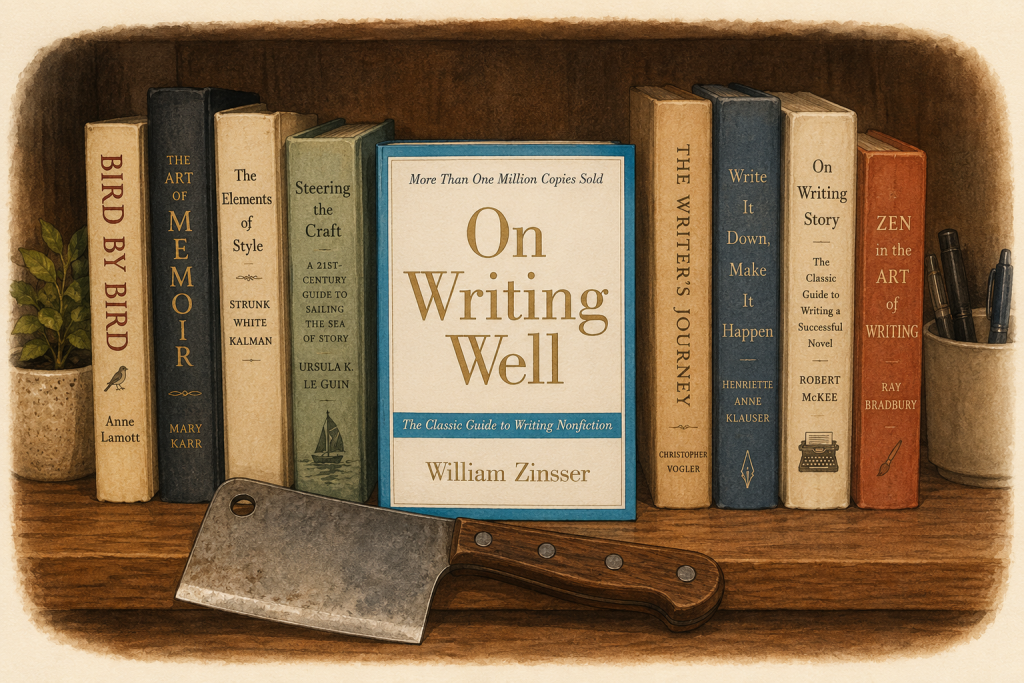
| Title | On Writing Well: The Classic Guide to Writing Nonfiction |
| Author | William Zinsser |
| Publisher | HarperCollins |
| First published | 1976 |
| Edition reviewed | 30th Anniversary Edition |
| Pages | 321 |
| Genre | Craft / Writing instruction / Nonfiction |
| Availability | In print; widely available |
| Price | ~$10 in paperback |
This post contains affiliate links. If you buy through them, I may earn a commission at no extra cost to you. Full disclosure policy.
Bottom line: The definitive guide to nonfiction writing, first published in 1976 and revised seven times since, by a Princeton-educated journalist who wrote for the New York Herald Tribune, taught writing at Yale, and considered clutter the enemy of all human communication in the same way that some people consider traffic or dishonesty the enemy. He was right, and the book proves it by being clear, warm, and almost entirely free of the thing it warns against.
Scribbright rating: 5 out of 5
Get On Writing Well on Amazon →
The lineup so far
If you’ve been elsewhere on this site, you might say that we’ve now reviewed enough books about writing, right? Well, On Writing Well is pretty obligatory because it’s a bedrock guide to nonfiction.
The Elements of Style is a useful rulebook: 105 pages on grammar and composition, and blunt about it. The Art of Fiction is the demanding professor: technically rigorous, high standards, not interested in your feelings about his standards. Bird by Bird is the warm friend: permission, encouragement, psychological survival guide. On Writing Well is like the working writer who has sat next to enough bad writing to know exactly what’s wrong with it, and who has been patient enough about that proximity to produce a book rather than just a complaint.

→ If you’re building out a writer’s bookshelf, the Scribbright reviews section covers books, planners, notebooks, and tools for the serious writing life.
Clutter is the enemy
Zinsser’s central argument is that clutter is the enemy of clear writing, and that most writers produce far more of it than they realize. Unnecessary words, redundant phrases, qualifications that add nothing, abstractions where concrete nouns would serve: these accumulate in drafts the way sediment accumulates in pipes, and the primary job of revision is to remove them.
This is a familiar argument. What makes Zinsser’s version of it stick is the specificity with which he pursues it. He doesn’t just say “cut unnecessary words.” He shows you, sentence by sentence, what unnecessary words look like in the wild and what the sentence looks like after they’ve been removed. The before-and-after examples throughout the book are the most practically useful feature of the text, and the most humbling: most writers will recognize their own habits in the before versions and feel the specific embarrassment of seeing them in print.
The instruction to simplify does not mean the instruction to be simple. This is the misreading that produces flat, bloodless prose. Zinsser is clear that simplicity is about removing what’s unnecessary, not removing what’s difficult. Complex ideas presented clearly are the goal. Simple ideas presented in complicated ways are the failure mode.
Voice
The second major thread in the book is voice, which Zinsser treats as both a craft element and a personal commitment. The instruction is to write with your own personality present on the page — not performatively, not affectedly, but in the sense that a reader should be able to feel the presence of a specific human being making choices about how to communicate a specific thing.
This is harder than it sounds, and Zinsser is honest about why. Most writers suppress their voice in formal or professional writing because they were taught to, or because they believe impersonal writing sounds more authoritative, or because they’re afraid of what their personality will reveal when it shows up in the prose. The argument against all of these is that readers notice the absence of personality before they notice its presence, and that a piece of writing that sounds like it was produced by a committee is less convincing than one that sounds like it was produced by a person.
The genres
The second half of the book is organized by genre, and it’s where On Writing Well distinguishes itself most clearly from general writing guides. Zinsser covers memoirs and personal narrative, science writing, business writing, sports writing, humor, criticism, and travel writing, with specific guidance for each. The breadth is the point: the principles of clarity and voice apply across all of them, but the application differs, and the genre-specific chapters make those differences concrete.
The memoir chapter is the one most Scribbright readers will find immediately useful. Zinsser’s guidance on writing about your own life — what to include, what to leave out, how to handle the people in it, how to find the theme that makes a personal story more than just personal — is practical and honest in a way that most memoir writing guides aren’t. He takes seriously the question of what makes a personal story worth reading to someone who isn’t you, and his answer is more specific than most.
The humor chapter is the one most writers are tempted to skip and shouldn’t. Zinsser’s treatment of humor as a serious craft element — not a decoration added to otherwise competent writing, but a way of thinking about the world that produces better prose across all genres — is one of the most useful arguments in the book, and the one most underappreciated in formal writing instruction.
How it sits against the other books
The Elements of Style and On Writing Well are often paired, and the pairing is instructive. Both argue for brevity and clarity. The Elements of Style arrives at that argument through rules, applied with Strunk’s characteristic impatience. Zinsser arrives at it through examples and principles, with considerably more warmth and a stronger sense of why the rules exist rather than just what they are.
Read The Elements of Style for the rules. Read On Writing Well to understand what the rules are for. The combination is more useful than either alone.
Bird by Bird is the emotional companion. On Writing Well is the professional one. They address different needs and different fears, and writers who benefit from one almost always benefit from the other.
The Art of Fiction is the most demanding of the group. Zinsser is demanding too, but in the way of a mentor rather than an examiner. He wants you to write better because he believes you can, which is a different pressure than Gardner’s, and for many writers a more sustainable one.
Bear in mind…
On Writing Well is about nonfiction, and its prescriptions are calibrated for nonfiction. Some of them apply directly to fiction; many apply only with significant modification. Gardner’s The Art of Fiction handles the fiction-specific territory better. For writers who work primarily in fiction and read On Writing Well looking for guidance that applies directly to their work, the experience is like getting excellent advice for a different job: useful to know, not always directly applicable.
Zinsser’s taste also runs toward a particular kind of clear, direct, journalistic prose that is not the only legitimate style in nonfiction. Tom Wolfe and Hunter S. Thompson broke practically every rule in this book, since writers who work in more lyrical, essayistic, or deliberately complex forms will find some of his edicts way too shackling. The principles remain sound; the specific applications are calibrated to his aesthetic, which is strong and consistent and not universal. My opinion? You’ve got to learn good, foundational writing before angling off into idiosyncrasy.
Pros
- The most comprehensive practical guide to nonfiction writing available in a single volume
- Before-and-after examples throughout make abstract principles concrete and immediately applicable
- Voice chapter addresses one of the most neglected elements of professional writing
- Genre-specific chapters on memoir, humor, science, travel, and business writing are unusually practical
- Zinsser practices what he preaches; the prose is clear, warm, and free of clutter
- Seven revised editions means the book has been updated across five decades; it doesn’t feel like a 1976 book
- Pairs naturally with The Elements of Style as a two-book foundation for any writer
Cons
- Focused on nonfiction; fiction writers will need to translate more than apply
- Zinsser’s taste in prose style is strong and specific; not everyone will share it
- Some cultural examples in older sections feel dated even in revised editions
- The humor chapter is excellent and often underread, which is a reader problem rather than a book problem
The verdict
On Writing Well is the book you give to a writer who wants to be better at their actual professional work — the emails, the reports, the essays, the memoirs, the articles, the content that constitutes most of what writers produce — rather than the novel they’re planning to write someday. It is the most directly applicable craft book in Scribbright’s growing library for that specific and large audience.
Zinsser died in 2015. The book is in its seventh edition. The advice is better than most of what’s been published since, which is either a statement about the quality of the advice or a mild indictment of how much writing instruction has improved in fifty years. Probably both.
Get On Writing Well on Amazon →
Michael Semer is a writer and editor with 40-plus years in advertising, PR, and content marketing who has read this book, assigned it, lost count of how many times he’s recommended it, and is aware of the irony of having written a review that is almost certainly longer than Zinsser would approve of.
→ More gear worth knowing about: Scribbright reviews writing tools, notebooks, keyboards, and desk essentials for writers who take the work seriously.
Frequently asked questions
What is On Writing Well about? On Writing Well by William Zinsser is a guide to nonfiction writing organized around two core principles: cutting clutter and writing with an authentic voice. The first half covers fundamental principles applicable across all nonfiction; the second half covers specific genres including memoir, science writing, business writing, humor, sports, criticism, and travel. First published in 1976 and revised through seven editions, it is the most widely recommended guide to nonfiction writing in English.
How does On Writing Well compare to The Elements of Style? Both argue for clarity and brevity. The Elements of Style arrives through rules applied with blunt authority; On Writing Well arrives through examples and principle with considerably more warmth. Read The Elements of Style for the rules; read On Writing Well to understand what the rules are for. The pairing is more useful than either alone.
Is On Writing Well useful for fiction writers? Partially. The principles of clarity, voice, and cutting clutter apply to fiction as well as nonfiction. The specific genre guidance and many of the examples are calibrated to nonfiction. Fiction writers will find On Writing Well useful for sentence-level craft and for work in non-fiction adjacent forms like memoir and personal essay. The Art of Fiction handles fiction-specific craft more directly.
What is the clutter argument in On Writing Well? Zinsser argues that clutter — unnecessary words, redundant phrases, abstract nouns where concrete ones would serve, qualifications that add nothing — is the primary enemy of clear writing, and that most writers produce far more of it than they realize. The instruction is not to simplify ideas but to remove the verbal accumulation around ideas that obscures rather than communicates them. The before-and-after examples throughout the book make the argument concrete.
Why does Zinsser emphasize voice? Zinsser argues that readers notice the absence of personality in writing before they notice its presence, and that impersonal writing is less convincing than personal writing, not more. Voice is treated as a professional craft element — the presence of a specific human being making deliberate choices about how to communicate — rather than a self-indulgent addition to formal writing.
Is On Writing Well still relevant? Yes. The latest edition incorporates updates across five decades, and the core principles have held up better than most writing instruction published since. The advice on clarity, clutter, and voice applies directly to digital writing, content marketing, and journalism as well as to traditional print forms. Some specific examples feel dated; the principles don’t.
Which edition of On Writing Well should I buy? The 30th Anniversary Edition is the current definitive version, incorporating all of Zinsser’s revisions through the final edition he supervised. Other recent editions are fine choices; the differences between editions are in updated examples and occasional revised sections rather than fundamental changes.