
Body Text here
At a Glance
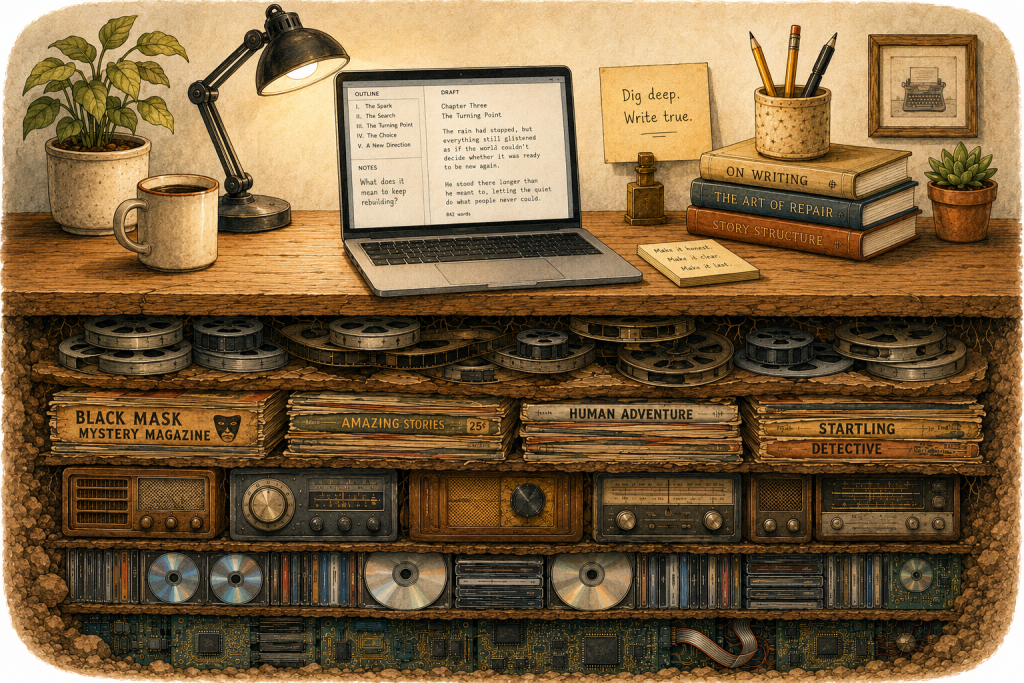
The problem with a profitable writing groove is in getting so deeply embedded in it, you can’t find your way out when the situation changes. See how previous generations of writers in different segments had to face down changes that struck down their livelihoods
The godfather of one of my daughters was a sportswriter for the Dallas Times Herald, once upon a time. The paper folded in 1991, he’s worked in PR ever since, and that’s just the nature of the writing business in general, not just journalism.
Here’s the part that’s frustrating: he didn’t get worse at sportswriting.
He was good at it right up until the last edition rolled off the press. The thing he was excellent at simply stopped existing underneath him.
Nobody plans for that, or for making a writing career change. We plan for rejection, dry spells, editors who ghost us. We do not plan for the entire category of work evaporating while our skills are at their peak.
If you write for a living today, you already know why this matters. AI didn’t just arrive in our industry; it moved in, rearranged the furniture, and started answering the phone. But before you decide this is a uniquely modern catastrophe, consider this: working writers have been through the same cycle at least half a dozen times in the past century.
The pattern is remarkably consistent.
So is the way out.
The comfortable rut has excellent acoustics
A career groove is a competence loop. You get good at something, the market rewards it, and you rationally optimize toward more of what pays. Every hour spent deepening the specialty returns money now, so you keep digging.
The groove gets smoother. Faster. More profitable.
Also, deeper. And the deeper it goes, the less of the horizon you can see from inside it.
That’s the trap. Not incompetence, not laziness, not a failure to hustle. The trap is that success itself narrows your field of vision at exactly the moment you can least afford tunnel vision. The better the groove pays, the less reason you have to look up.
Everything sounds fine down there. The acoustics are great.
Curious what tools are actually worth a working writer’s money? Browse everything we’ve tested at Scribbright reviews.
Five times the floor moved under working writers
Don’t take my word for it. Take a century of writing category catastrophes into account that forced a writing career change on professionals who thought they had a good thing locked up.
The title writers talkies erased
In 1926, Hollywood employed a whole class of specialists called title writers, the people who wrote the witty intertitle cards for silent films. The best of them were famous, credited, and paid like stars.
Then The Jazz Singer premiered in 1927. Synchronized sound swept the industry, and within about three years the profession didn’t exist.
A few title writers made the jump to dialogue. Most didn’t, because writing a ten-word zinger for a card and writing dialogue an actor can actually say are different skills. The writers who’d optimized hardest for the card were furthest from the future.
A penny a word until the distributor died
The pulp magazines of the 1930s and 40s supported thousands of writers producing staggering volume at a penny or two a word. The groove was the volume itself: write fast, sell everything, then repeat, for pulps like The Shadow, Doc Savage, Astounding Science Fiction and scores of others.
Then the groove ran out of magazines. Wartime paper rationing wounded the pulps. Comic books grabbed younger readers. Paperbacks and television bled them. And in 1957, the collapse of American News Company, the distributor that carried most of them to newsstands, finished the job almost overnight.
The survivors (Ray Bradbury, Louis L’Amour, Elmore Leonard) had already been sidling into paperback originals, the slicks, or screenwriting while the pulp checks were still cashing.
The ones who’d perfected the penny-a-word groove and nothing else went down with the newsstands.
Radio drama’s ten-year goodbye
Radio dramatists were a golden-age profession in 1948. By 1962, when the last network dramas went off the air, the job was gone. Television didn’t ask permission; it just shanghaied the audience.
Writers who understood story adapted, and plenty did. Writers who had optimized purely for audio, the sound-effects choreography, the theater of the mind, discovered their most refined skills were precisely the non-transferable ones.
Read that sentence again if you’ve spent the last decade perfecting the 1,200-word SEO post.
Encarta killed Britannica, then Wikipedia killed Encarta
Encyclopedia writing was steady, respectable freelance work for decades. Microsoft’s Encarta, bundled cheap on CD-ROM, gutted Britannica’s print business in the 1990s. I was there: Britannica was a promotions client of mine in Chicago, and you practically could smell the desperation in the hallways.
When that went away, I got Encarta as a client. Then Wikipedia, written by volunteers for free, killed Encarta itself in 2009.
Maybe I’m just bad luck.
Two extinction events in roughly fifteen years. And here’s the kicker: being on the disruptor’s payroll didn’t save Encarta’s contributors, either.
The lesson isn’t “pick the winning platform.” The lesson is that no platform is built on anything but shifting sands. Sometimes it just takes longer for the foundation to crumble.
The day Google Panda ended the content farm
This one is the closest ancestor to right now. In early 2011, thousands of writers were churning out $15 articles for Demand Media’s eHow and its imitators, a groove that genuinely felt like the future of freelancing.
Then Google shipped the Panda update in February 2011. Content-farm traffic cratered, and the market for that work vanished in weeks.
No new technology. No new competitor. An algorithm changed its mind, and an entire tier of writing income disappeared.
If your livelihood depends on an algorithm’s continued approval, you’re renting your groove. You don’t own it.
AI is the same story with better data
Which brings us to now. For the first time, we get to watch the trap close in real time, with actual numbers.
A study by researchers at Imperial College London, Harvard Business School, and the German Institute for Economic Research analyzed nearly two million freelance job postings across 61 countries. Within eight months of ChatGPT’s launch, demand for freelance writing work fell roughly 31 percent, the steepest decline of any category they measured.
But that number isn’t what should keep you up at night.
Researchers studying Upwork expected experience to be armor. Surely the top-rated, higher-priced freelancers would be insulated while the bottom of the market took the hit..?
The data showed the opposite. The more a freelancer had earned before, the harder the fall afterward: one analysis found that every 1 percent increase in past earnings predicted an additional half-percent decline in job opportunities and a 1.7 percent decline in monthly income after AI tools arrived.
Seniority in the groove wasn’t protection. It was exposure.
The writers who had optimized most completely for the pre-AI market had the most invested in exactly the work AI could imitate. Their leverage was pointed the wrong way.
Meanwhile, the same market data shows the other side of the split. Commodity content is collapsing while specialists gain ground: finance writers averaging around $73,000 a year, white paper specialists commanding $6,000 a month and up. Fewer clients, bigger checks, and the checks go to writers whose work requires judgment, access, and accountability a model can’t fake.
I’ve seen this from the inside-out. The clients who used me for regularized, SEO-type content? They went away. The ones who needed specialized content or strategy? I still hear from them.
What the survivors had in common
Run the century back and the survivors share three traits.
None of them is talent. Talent was table stakes. The title writers and pulp veterans who vanished were plenty talented.
First, the survivors held a second skill adjacent to the dying one. The pulp writers who could structure a paperback novel. The radio dramatists who understood visual pacing. The sportswriter who could turn sourcing and deadline discipline into a PR career. The adjacent skill doesn’t have to be glamorous. It has to exist before you need it.
Second, they were attached to readers and clients, not to a format or a platform. Formats die. Platforms change their minds (ask the eHow writers). Relationships with people who trust your judgment survive the format they first met you in. That’s why retainer relationships and ongoing content programs are holding up right now while one-off commodity gigs get handed to a chatbot. Trust and accumulated context are the parts AI can’t ship.
Third, and this is where it’s uncomfortable for some: they moved before they had to, while the old groove was still paying. Bradbury didn’t wait for the pulp to die. Nobody sends a memo announcing the floor is about to move. By the time the evidence is undeniable, the exits are crowded.
An honest audit for your own groove
So here’s the exercise. Do it on paper, not in your head. Your head will flatter you and tell you you’ll do just fine, no worries!
Question one: if your primary format vanished in eighteen months, what would you actually have to sell? Not what you could theoretically learn. What you could invoice for next quarter. If the answer is a blank stare, that’s not a character flaw. It’s a to-do list.
Question two: does your income depend on a platform’s algorithm or on a client’s trust? Be brutally honest about the ratio. Algorithm-dependent income is real money, but it’s money with a landlord, and the landlord can renovate without notice.
Question three: when did you last do paid work outside your specialty? Not a hobby. Not a someday project. Paid work, because payment is the only proof that a skill is market-ready rather than aspirational. If it’s been more than a couple of years, your adjacent skill may be more theoretical than you’d like to believe.
None of this means abandoning your groove. The groove is where the money is, and compounding expertise is still the best deal in this business.
It means keeping one foot on ground the groove doesn’t control. So you’ve got a contingency plan in hand if a writing career change becomes urgent.
When to make a writing career change?
The groove isn’t the enemy. Grooves are how writing careers compound; nobody builds a reputation by being adequate at twelve things.
The trap is mistaking the groove for the ground.
Every generation of writers who got blindsided was standing on something that felt permanent right up until it wasn’t: the intertitle card, the pulp newsstand, the radio dial, the classified page, the content farm.
And yet my daughter’s godfather is still working, thirty-five years after his newspaper stopped existing.
The groove died. The career didn’t.
So have another groove in mind. Put together a writer’s survival kit of contacts, skills and options that can keep you afloat, or better, when it looks like your groove is narrowing. Because it may narrow to nothingness.
That option is available to every one of us. But only if we make it before the last edition rolls off the press.
Want to sharpen the tools you’ll carry into whatever comes next? Every keyboard, app, and notebook we’ve reviewed lives at Scribbright reviews.
FAQ
Is AI actually replacing writers, or just replacing cheap content?
Mostly the latter, but the line keeps moving. The steepest losses have hit commodity work: generic SEO posts, product descriptions, basic copywriting. Specialized work built on expertise, reporting, and client trust has held up and in many niches gotten more valuable. The risk isn’t that AI replaces writing. It’s that it replaces the specific kind of writing you’ve optimized for.
What writing skills are hardest for AI to replicate?
Anything requiring accountability and access: original reporting, subject-matter expertise earned through experience, judgment about what a specific client should say (and shouldn’t), and relationships that give you information a model can’t scrape. Voice matters too, but voice alone won’t save you. Voice plus expertise will.
How do I know if my writing niche is at risk?
Ask whether a client could get 80 percent of your deliverable from a chatbot in ten minutes. If yes, your niche is at risk no matter how good you are, because the market prices against the 80 percent solution. If your work requires interviewing humans, interpreting proprietary data, or taking responsibility for being right, you’ve got more runway. Use it to build the adjacent skill anyway.